Friday, 25 March 2011

Peace Sign: The Most Awesome Symbol Ever

50 years had passed. Another 100 will pass and there is always going to be someone who is wondering what is that mark standing for. It started life as the emblem of the British anti-nuclear movement but it has become an international sign for peace, and arguably the most widely used protest symbol in the world. It has also been adapted, attacked and commercialised.Many people have speculated on just what the symbol represents; some religious zealots even claim it signifies Christ on the cross with arms broken, or a Teutonic rune representing death and despair. But the truth is not so mysterious.
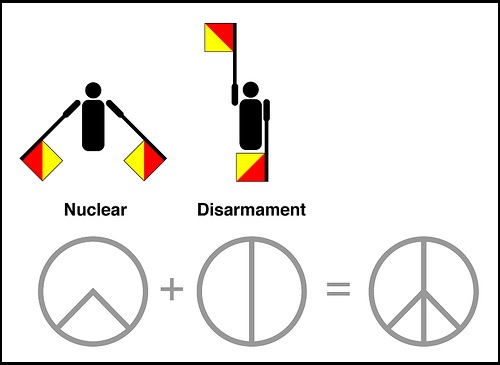

What does it mean?

One of the most widely known symbols in the world, in Britain it is recognised as standing for nuclear disarmament —and in particular as the logo of the Campaign for Nuclear Disarmament (CND). It was designed from the naval code of semaphore, and the symbol represents the code letters for ND which means Nuclear Disarmament.The circle, representing the concept of total or complete, surrounds the N and D signifying total or complete nuclear disarmament.
In the United States and much of the rest of the world it is known more broadly as the peace symbol. It was designed in 1958 by Gerald Holtom, a professional designer and artist and a graduate of the Royal College of Arts. He showed his preliminary sketches to a small group of people in the Peace News office in North London and to the Direct Action Committee Against Nuclear War, one of several smaller organisations that came together to set up CND.
The Direct Action Committee had already planned what was to be the first major anti-nuclear march, from London to Aldermaston, where British nuclear weapons were and still are manufactured. It was on that march, over the 1958 Easter weekend that the symbol first appeared in public. Five hundred cardboard lollipops on sticks were produced. Half were black on white and half white on green. Just as the church’s liturgical colours change over Easter, so the colours were to change, “from Winter to Spring, from Death to Life.” Black and white would be displayed on Good Friday and Saturday, green and white on Easter Sunday and Monday.
The first badges were made by Eric Austin of Kensington CND using white clay with the symbol painted black. Again there was a conscious symbolism. They were distributed with a note explaining that in the event of a nuclear war, these fired pottery badges would be among the few human artifacts to survive the nuclear inferno. These early ceramic badges can still be found and one, lent by CND, was included in the Imperial War Museum’s 1999/2000 exhibition ”From the Bomb to the Beatles”.

Later, in a letter, Holtom also admitted that the symbol reflected his mood at the time. “I was in despair,” he wrote. “Deep despair. I drew myself: the representative of an individual in despair, with hands palm outstretched outwards and downwards in the manner of Goya’s peasant before the firing squad. I formalized the drawing into a line and put a circle around it.”
American journalist and playwright Herb Greer adds support for the Holtom explanation. He reported, “I was actually there on and before the first Aldermaston march for which it was created. I visited Holtom, I saw the original sketches and discussed it with him.”
Ken Kolsbun, author of the book Peace: The Biography of a Symbol, reported that Holtom expressed regret in not designing the peace symbol with the joyful lifting of arms towards the sky. For most of Holtom’s life he would draw only the upright peace symbol. Holtom requested that the upright peace symbol be placed on his tombstone in Kent, England. If we take a look on  the picture of his tombstone, we’ll see that  his wish was unfortunately ignored.
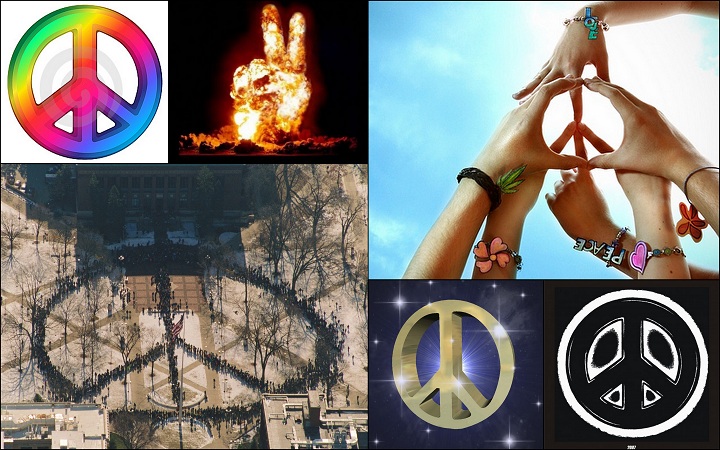
While it appears reasonable that the modern day peace symbol comes from Gerald Holtom, this logic fails to address the fact that the symbol has been used for evil both in modern times and for thousands of years.
This same symbol was used by Hitler’s 3rd Panzer Division from 1941 to 1945.  The image on the left is the regimental 3rd Panzer Division symbol. Soviet, Polish, and Hungarian citizens, having suffered from the Nazi massacres, undoubtedly struggled with Holtom’s use of the symbol as a thoughtful way to communicate peace. The symbol can also be found on some of Hitler’s SS soldiers’ tombstones.
Another flaw in the Holtom creation story is the use of the symbol as an anti-Christian symbol by the Saracens as early as 711 A.D.For the Saracens, the image placed on their shields symbolized the breaking of the Christian cross. For some the broken cross was equated to a satanic symbol known as the raven’s craw or witch’s foot. While Holtom may not have known the historical meaning of the peace symbol, Bertrand Russell was a historian and member of the Fabian Society. A 1970 article in the American Opinion magazine claimed Russell knew the historical occult meaning and intentionally selected an “anti-Christian design long associated with Satanism.”
The fifth and final Roman emperor of the Julio-Claudian dynasty, Nero (born Lucius Domitius Ahenabarbus 37 – 68 AD), is remembered in history for persecuting Christians. Nero’s rule was so wicked he even had his mother executed. The First Roman-Jewish War (66 – 70 AD) started during his reign and today the term “Nero Cross” is the symbol of the “broken Jew” or “broken cross.” The most famous person believed to be crucified by Nero was the Apostle Peter. To symbolize humility and unworthiness in comparison to Christ, Peter requested that he be crucified with his head toward the ground. As a result of Peter’s death the upside down cross was used by early Christians as a positive symbol for peace.
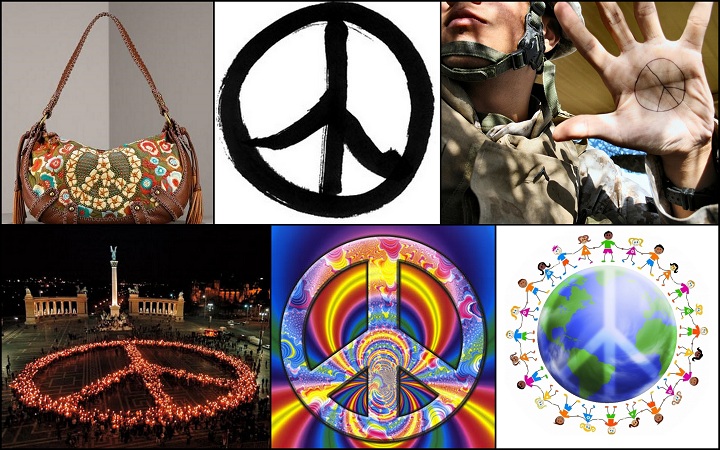
The symbol of the upside down cross changes its meaning when the person on the upside down cross is no longer Peter but Jesus. Anti-religious and satanic groups use the “Nero Cross” or inverted “Latin Cross” to symbolize everything opposite of Christianity. Today this is clearly illustrated by “black metal” or heavy metal music lyrics and imagery that communicate anti-Christian sentiments.  In addition to musicians, film makers have reinforced the notion that the upside down cross is an anti-Christian symbol as illustrated by The Omen in 1976 and The Exorcism of Emily Rose in 2005.
The symbol has also been used to communicate support for communism. Bertrand Russell once said: “There is no hope in anything but the Soviet way.” Governments–both those who supported communism and those opposed to it–have perceived benefits in aligning the peace symbol with communist ideology. For people like Bertrand Russell, the author of the 1927 essay Why I Am Not Christian, the symbol represented not only a pro-communism meaning but peace without God.

CND has never registered the sign as a trademark, arguing that “a symbol of freedom, it is free for all”. It has now appeared on millions of mugs, T-shirts, rings and nose-studs. Bizarrely, it has also made an appearance on packets of Lucky Strike cigarettes.A decade ago, the sign was chosen during a public vote to appear on a US commemorative postage stamp saluting the 1960s.The symbol that helped define a generation of baby boomers may not be as widely used today as in the past. It is in danger of becoming to many people a retro fashion item, although the Iraq war has seen it re-emerge with something like its original purpose.
“It is still the dominant peace sign,” argues Lawrence Wittner, an expert on peace movements at the University at Albany in New York.”Part of that is down to its simplicity. It can be used as a shorthand for many causes because it can be reproduced really quickly – on walls on floors, which is important, in say, repressive societies.”
And can its success be measured? Fifty years on, wars have continued to be waged and the list of nuclear-armed states has steadily lengthened.But the cup is half-full as well as half empty.
“There are many ways in which nuclear war has been prevented,” says Mr Wittner. “The hawks say that the reason nuclear weapons have not been used is because of the deterrent. But I believe popular pressure has restrained powers from using them and helped curbed the arms race.And the symbol of and inspiration for that popular pressure, says Mr Wittner, is Mr Holtom’s graphic.
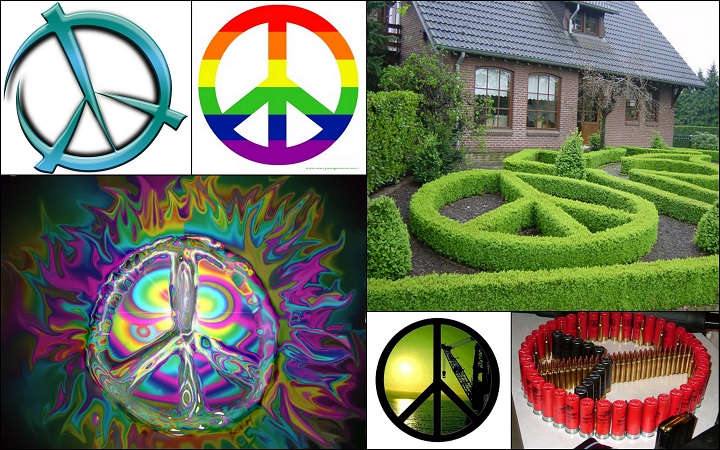
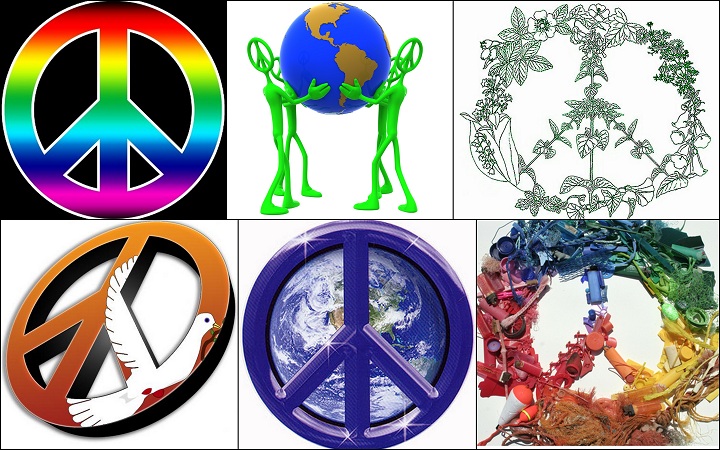
“Today because many people carry the symbol without understanding the history, we miss an opportunity to address historical uses and move forward to reclaim the symbol for good.When you see the peace symbol, I encourage you to see the person displaying it as communicating a message of love.If you display the peace symbol, my recommendation is point the arms of the peace symbol toward the sky to honor Holtom’s wish, address historical objections, and communicate love of all people.”Dave Dionisi, Teach Peace Foundation

Duck, everybody: two asteroids to zip close by Earth today

Later today, two asteroids will swing so close to the Earth that they pass between us and the orbit of the moon.
Anyone with a reasonable-sized amateur telescope should be able to spot the objects, which are both a few meters in diameter. However, because they are moving so fast, observers will need sharp eyes.

Neither has any chance of hitting Earth, says NASA.
The Catalina Sky Survey near Tucson, Arizona, discovered both objects on Sunday morning, during a routine scan of the skies. The Minor Planet Center in Cambridge, Massachussetts worked out the orbits.
Near-Earth asteroid 2010 RX30 is estimated to be 10 to 20 meters in size and will pass within 248,000 kilometers of the earth at 2:51am PDT today. The second object, 2010 RF12, is a little smaller at around 6 to 14 meters in size, but will come even closer, at 79,000 kilometers from Earth, at 2:12pm PDT.
What's unusual is for two asteroids to make such close passes at almost the same time. In fact, with around 50 million undiscovered asteroids out there, NASA reckons the odds are that one this size passes this close almost daily. One might strike Earth's atmosphere about every 10 years on average, it says.
More worrying is an asteroid predicted to arrive in 2182, which has a one-in-a-thousand chance of hitting Earth unless it is deflected.
Earlier this year, a new telescope in Hawaii started searching for potentially dangerous asteroids. However, the National Academy of Sciences recently warned that NASA's near-Earth asteroid tracking program may be in danger of running out of funds.

Child Abuse

http://www.metacafe.com/watch/60058/child_abuse/

Volcano Creat Hole

Stunning pictures of the volcano that blew a hole in the sky as astronauts witness eruption from International Space Station

By Eddie Wrenn
Last updated at 7:46 PM on 25th June 2009

Framed by a circle of clouds, this is a stunning illustration of Nature's powerful force.

A plume of smoke, ash and steam soars five miles into the sky from an erupting volcano.

The extraordinary image was captured by the crew of the International Space Station 220 miles above a remote Russian island in the North Pacific.

Enlarge   Bird's Eye View: Safe from harm, NASA scientists look down on the Sarychev Peak volcano as the dramatic eruption takes place. The force of the blast sends clouds scattering
Bird's eye view: Safe from harm, NASA scientists look down on the Sarychev Peak volcano as the dramatic eruption takes place. The force of the blast sends clouds scattering

The round hole in the clouds is thought to have been caused by the shockwave of the initial explosion. At the centre lies the billowing mushroom tower of grey and brown ash.

For volcano experts, the most exciting part of the image is the layer of smooth white cloud that caps the plume - a little like a layer of snow on a mushroom.

This cap of condensed air is created from the rapid rising and then cooling of the air directly above the ash column. When moist, warm air rises quickly it creates a cloud.


As the ISS continues its perfectly-timed flyby, the eruption continues unabated. The perfect 'plume' at the top of the volcano implies there is no shearing wind, which would have disrupted the pattern
Stretching behind the volcano lies the vast shadow caused by the eruption, as the blast continues to grow

This cap, which meteorologists call a pileus cloud, is already beginning to break up in these images - and would have vanished soon afterwards.

Far below, a thunderous line of light grey cloud can be seen falling down the sloping sides of the volcano. 


This is a deadly pyroclastic flow - a mixture of hot gas and ash that destroys everything in its path.

Reaching temperatures of 600C (1,112F) and moving at 130mph, a pyroclastic flow is the most dangerous part of a volcanic eruption.


Where in the world? Sarychev Peak is to the north of Japan and east of Russia

Thankfully, Matua Island is uninhabited. The eruption of Sarychev Peak began a week ago and is still under way. The International Space Station has continued to track the ash cloud over the last few days.

The plume is a few hundred miles from one of the world's busiest air corridors. Hundreds of flights across the Pacific have been diverted to avoid any chance of it knocking out plane engines.

Sarychev Peak is one of the most active volcanoes in Russia's Kuril archipelago. Eruptions have been recorded as far back as the 1700s, with the last known one in 1989.

Plume
These images show the plume drifting through the atmosphere in the hours and days after the eruption

Eruption
Between the two overpasses on June 14, the ash spread north and west from the volcano
Spreading
By June 15, the ash had spread out to the east and west

You've seen the hole in the clouds - now see the hole in the universe:


A hole in the clouds is one thing, but a hole in the fabric of the universe is quite another.

With interstellar matter evenly distributed across the skies, this black anomaly is a bit of a head-scratcher - is it a black hole? A worm-hole? A stairway to Heaven? Or just the start of the collapse of the universe, which doomsayers assure us will start in 2012?
No, it's none of these things. Instead, its a dark molecular cloud - a mass of of dust and gases which combine to blank out all the visible light from the background stars.
Many of these 'dark absorption nebulae' have been discovered across the galaxy, with this one called Barnard 68 in the Ophiuchus constellation.
NASA's 'hole in the sky' - now known to be a dark, molecular cloud absorbing all the visible light from stars behind it
NASA's picture of the 'hole in the sky' - now known to be a dark molecular cloud absorbing all the visible light from stars behind it
Measurements place this at a relatively close 500 light years away - much further away and the odds are there would be stars visible in front of Barnard 68.
It is calculated to be about half-a-light year across (a light-year being the distance light can travel through a vacuum in the course of a year).
How they are formed is unknown, but clouds such as this are thought to be a birthing place for new stars.

bridge shakes during earthquake

Thursday, 24 March 2011

Battledore and Shuttlecock

Battledore and Shuttlecock or Jeu de Volantis is an early game similar to that of modern Badminton.
This game is played by two persons with small rackets, called battledores, made of parchment or rows of gut stretched across wooden frames, and shuttlecocks, made of a base of some light material, like cork, with trimmed feathers fixed round the top.
The object of the players is to bat the shuttlecock from one to the other as many times as possible without allowing it to fall to the ground.
Games with a shuttlecock are believed to have originated in ancient Greece about 2000 years ago. From there they spread via the Indo-Greek kingdoms to India and then further east to China and Siam.
There are Greek drawings extant representing a game almost identical with battledore and shuttlecock, and it has been popular in India, China, Japan, and Siam for at least 2000 years. In Europe it has been played by children for centuries. A further development is Badminton.

History of Football

ootball also known as American Football is a sport played between two teams competing for territory on a football field using a ball and set play. The objective of the game is getting the ball to the opposing team's goal line by either scoring a running touchdown or by kicking the ball over the post and between the uprights of the goal. It is not like soccer which has a goal keeper; instead it is more similar to Rugby and Australian Rules football.

Rugby which was the predecessor of Football was invented in England during 1860s. Its forerunners are similar to soccer and dates back to the middle ages when groups of rival villages competed to score a goal against each other.

In England during the 1860s, some schools, universities and clubs got together to form a set of rules allowing different teams from different schools and districts to play with each other. The published rules were the predecessor of modern soccer. However, every teams did not accept them and chose make their own code known as rugby.

The rules of football date back to the English parent games. American Football is also native to North America and old versions were played in the early 1800s in Princeton. The game was called ‘Ballown' and it eventually became known as football but the rules kept on changing.

A similar form of game was played at Harvard University which was greatly enjoyed by senior students. The game was called ‘Bloody Monday' as it was played on first Monday of the academic year.

When the rules of rugby and soccer were agreed on in England, the US entered a new period of prosperity brought about by the end of the civil war. Princeton and Rutgers created their own rules and played the very first intercollegiate game of football on the 6th November 1869.

When the intercollegiate games were admired, the representatives from Princeton, Rutgers, Columbia and Yale met to formulate a set of rules to be used for future intercollegiate games. They established the Intercollegiate Football Association and adopted many of the rules of rugby.

Football in the Americas was very much similar to rugby had its dissenters. One was Walter Camp of Yale who wanted a shorter playing field and fewer players.

American style football became more popular with Americans than the older rugby styled game. Colleges in the US soon adopted Camps new rules and established American Football as the leading football code.

During the 1890s, many colleges banned the game for being very rough with serious injuries. Later President Roosevelt called on the National Collegiate Athletic Association (NCAA), successor to IFA, to eliminate brutality from the game. Changes were made which were so successful to American Football that non college teams based around community athletic clubs formed and began to compete against each other.

Professional football and the NFL started to dominate with increasing viewers by the 1950s. A rival association called the American Football League (AFL) started in areas not already serviced by NFL teams and quickly competed for the best players, viewers and network broadcasting contracts numbers, and network broadcasting contracts. In 1970, NFL and AFL were merged and expressed as an important moment in the history of American Football. A stronger league also emerged and created the Super Bowl as its defining championship game.

History of cricket

Cricket is undoubtedly one of the most popular games in the world. The game probably originated as a pastime for shepherd children in England and survived for centuries before the first known match was played between English Counties in 1709. In the 18th century cricket left the shores of England and entered the various British Colonies like the West Indies and India and then into Australia when it was colonized in 1788. This was followed by its introduction in New Zealand and South Africa in the beginning of the 19th century.
The first laws of cricket were brought into force and subsequently amended in 1774, when new items like the leg before wicket rule, middle stump and the maximum permissible width of a bat were added to the existing rules. These laws also held that the principals or captains would choose a couple of gentlemen from the crowds present to settle all disputes to be known as umpires. The codes were formulated by the Star and Garter Club whose members subsequently formed the Marylebourne Cricket Club (MCC) at Lord’s Cricket ground in 1787. The MCC thereafter became the custodian of the Laws and has been responsible for all changes, alterations made to it.
Initially bowling was done by rolling the ball all along the ground but later bowlers started tossing the ball up and came with variations to the movement of the ball in the air or after pitching and the arts of swing and seam and spin bowling were born. The overarm bowling action was formally legalized only as late as 1864.Initially the bats were shaped like hockey sticks which were effective when the ball was rolled along the ground, were totally useless against swing bowling and the first straight edged bat was born.
Probably the Greatest of England cricketers, Sir W.G.Grace, made his debut in first class cricket 1865. His skills were exemplary and he brought numerous technical changes which was widely acclaimed. He, incidentally was the only ever victim of Sherlock Holme’s creator Arthur Conan Doyle in a county match.
In 1877, and English side went over to and played two matches against the Australian national side. These were the first Test matches ever played. In reply the Australians toured England in the following year for the first time. But the most famous tour came about in 1882 and the legendary match at The Oval gave rise to The Ashes, which to this day remains the most famous cricket trophy in the World. South Africa became the third Test playing nation in the year 1889. The rest of the major Test playing nations started playing much later.


blogger templates | Make Money Online

Free Wordpress, Blogger
Download Free Wordpress, Blogger Joomla, Themes
www.arslan0345.blogspot.com